Human Hands, Irreplaceable Vision: How Emerging Artists Are Reclaiming the Soul of Creativity
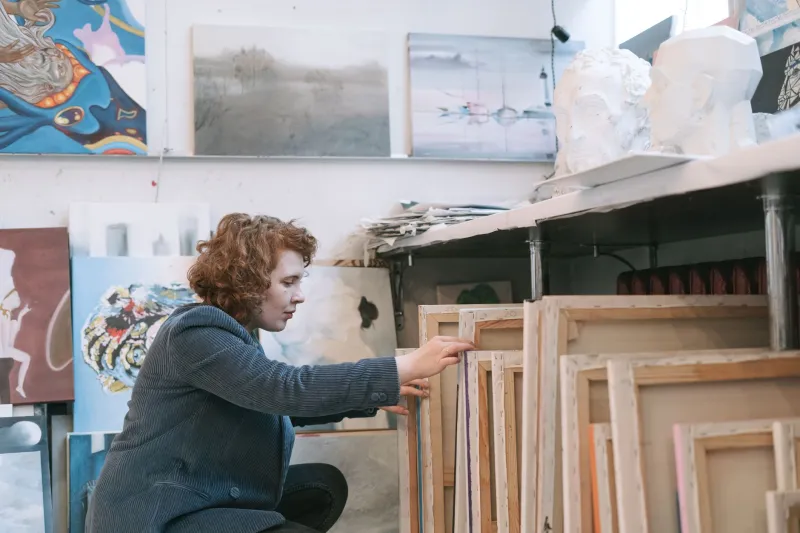
There is a particular kind of silence that settles over a painter's studio in the early morning — the smell of linseed oil, the resistance of a stretched canvas, the deliberate drag of a brush loaded with pigment. It is a silence that no algorithm has ever inhabited. And for a growing number of emerging artists across the United States, that distinction is not merely sentimental. It is existential.
The rapid proliferation of AI image-generation tools — Midjourney, DALL-E, Stable Diffusion, and their ever-multiplying successors — has reshaped the visual landscape with a speed that has left many in the art world breathless. What once required years of technical mastery and conceptual development can now be approximated, at least superficially, within seconds. The implications for emerging artists, those still building their reputations and livelihoods, are profound and, in many cases, deeply unsettling.
The Argument That Won't Go Away
Defenders of AI-generated imagery often frame the debate as a tired resistance to technological progress — the digital equivalent of painters decrying photography in the nineteenth century. It is a comparison that many working artists find both reductive and historically inaccurate.
"Photography didn't scrape the work of living artists without consent to train itself," says Dominique Ferrell, a mixed-media painter based in Chicago whose layered figurative canvases explore Black American domestic life. "It didn't absorb the visual language of thousands of creators and then produce commercial facsimiles that undercut those same creators in the marketplace. The analogy flatters the technology."
Ferrell's critique touches on what has become the central grievance among artist advocacy communities: the training data problem. Most major AI image models were built using datasets compiled from the internet — datasets that included, without permission or compensation, the copyrighted work of countless visual artists. Legal battles are ongoing, and the outcomes remain uncertain. But for many creators, the ethical breach has already occurred, regardless of how courts eventually rule.
Philosophy as Resistance
Rather than waiting for legal or legislative remedies, a significant cohort of emerging artists has responded by doubling down on the philosophical underpinnings of their practice. The argument, articulated with increasing sophistication, is that authentic art is not simply a visual output — it is the residue of a life lived, a body that has moved through the world, a consciousness that has suffered, celebrated, and chosen.
Marcus Yee, a ceramicist and installation artist working out of Oakland, describes his response to AI's rise as a clarification of purpose. "It forced me to ask why I make things," he explains. "And the answer I kept arriving at was: because the making itself is meaning. The calluses on my hands, the hours of failure, the physical negotiation with clay — that's not incidental to the work. That is the work."
This emphasis on process over product has gained traction not only among studio artists but within curatorial circles as well. Several independent galleries in New York, Chicago, and Los Angeles have begun explicitly foregrounding provenance and process in their programming — hosting open studio events, publishing detailed artist statements that document methodology, and in some cases requiring documentation of the physical labor involved in creating exhibited works.
Gatekeeping as a Creative Act
The word "gatekeeping" carries negative connotations in many contemporary conversations, often implying exclusionary elitism. But within the current art-world debate, some practitioners are reclaiming it as a necessary form of cultural stewardship.
Sarah Okonkwo, director of a mid-sized gallery in Washington, D.C. that focuses on emerging artists of color, is direct about her curatorial stance. "We don't show AI-generated work, and we're transparent about that policy," she says. "That's not about being anti-technology. I use technology constantly. It's about what we are here to do, which is to create economic opportunity and cultural visibility for human artists who have invested their lives in this work."
Okonkwo notes that collectors visiting her gallery have become increasingly vocal about their desire for what she calls "verifiable humanity" — work that carries the unmistakable evidence of individual authorship, cultural specificity, and embodied experience. "There's a hunger for the real," she observes. "Partly because the artificial has become so ubiquitous."
This collector sentiment is echoed by independent art advisor Priya Shenoy, who works primarily with first-generation collectors in the Northeast. "My clients are asking questions they never asked before," Shenoy notes. "They want to know the story behind the work. They want to meet the artist. They want to understand what the piece cost the person who made it — not financially, but personally. AI simply cannot offer that."
Collaborative Futures, on Human Terms
Not every emerging artist has adopted a position of outright opposition to artificial intelligence. A nuanced middle ground is taking shape among creators who are willing to engage with AI as a tool while insisting on the primacy of human direction and intention.
Jordan Calloway, a multidisciplinary artist based in Atlanta whose practice spans video, sculpture, and performance, uses AI-generated imagery as raw material — deliberately distorting, printing, and physically intervening in algorithmically produced images to critique the technology itself. "I'm interested in what happens when you introduce friction," Calloway explains. "When you make the machine's output strange again by running it through a human body, a human hand, a human decision."
This approach — treating AI as subject matter rather than author — is gaining visibility in experimental art spaces and biennials, where the conversation around technology tends to be more theoretically adventurous. But even within this framework, the artists involved are careful to position themselves as the primary agents of meaning-making.
"There's a difference between an artist using AI and AI replacing an artist," Calloway says. "The difference is authorship. The difference is who is asking the question."
What Comes Next
The conversation is far from settled, and its resolution — if any resolution is possible — will likely unfold across multiple fronts simultaneously: in courtrooms, in Congress, in gallery policies, and in the evolving standards of collectors and institutions. The College Art Association and several other professional bodies have begun developing ethical guidelines, though enforcement remains aspirational.
What is already clear, however, is that the AI-generated art debate has catalyzed something generative among the emerging artist community. It has prompted a renewed and urgent interrogation of first principles — of why art is made, what it communicates, and what obligations exist between creators, institutions, and the broader culture.
For Dominique Ferrell, that interrogation has been, despite everything, clarifying. "I know exactly why I paint now," she says, standing in her studio surrounded by large-scale canvases dense with color and memory. "I paint because these stories belong to living people. Because this light, this specific light I'm trying to capture, has never existed before and will never exist again. No machine trained on the past can reach for something genuinely new. But I can."
In an era of algorithmic abundance, that insistence on irreducible human presence may be the most radical artistic statement of all.